Openreach is retiring the UK's traditional PSTN (Public Switched Telephone Network) and ISDN by January 2027. If your business still has an analogue line, an ISDN2/30, an alarm dialler on a copper pair or a fax machine on the wall, it will stop working.
This isn't a sales scare - it's a national infrastructure programme that's already underway. The good news: the replacement (VoIP over your existing internet) is cheaper, more flexible and, done properly, invisible to your customers.
Here's what actually needs to happen.

What is the PSTN switch-off?
The PSTN is the copper telephone network that has carried UK voice calls for decades. Openreach - the wholesale arm of BT that owns the physical lines - is turning it off because keeping obsolete analogue kit alive costs more every year than replacing it with an all-IP (internet-based) network.
Every voice service currently delivered over PSTN or ISDN has to move to an IP-based replacement before the switch-off completes. In practice that means VoIP (Voice over IP) - your phone calls travel over your internet connection instead of a dedicated copper line.
The timeline
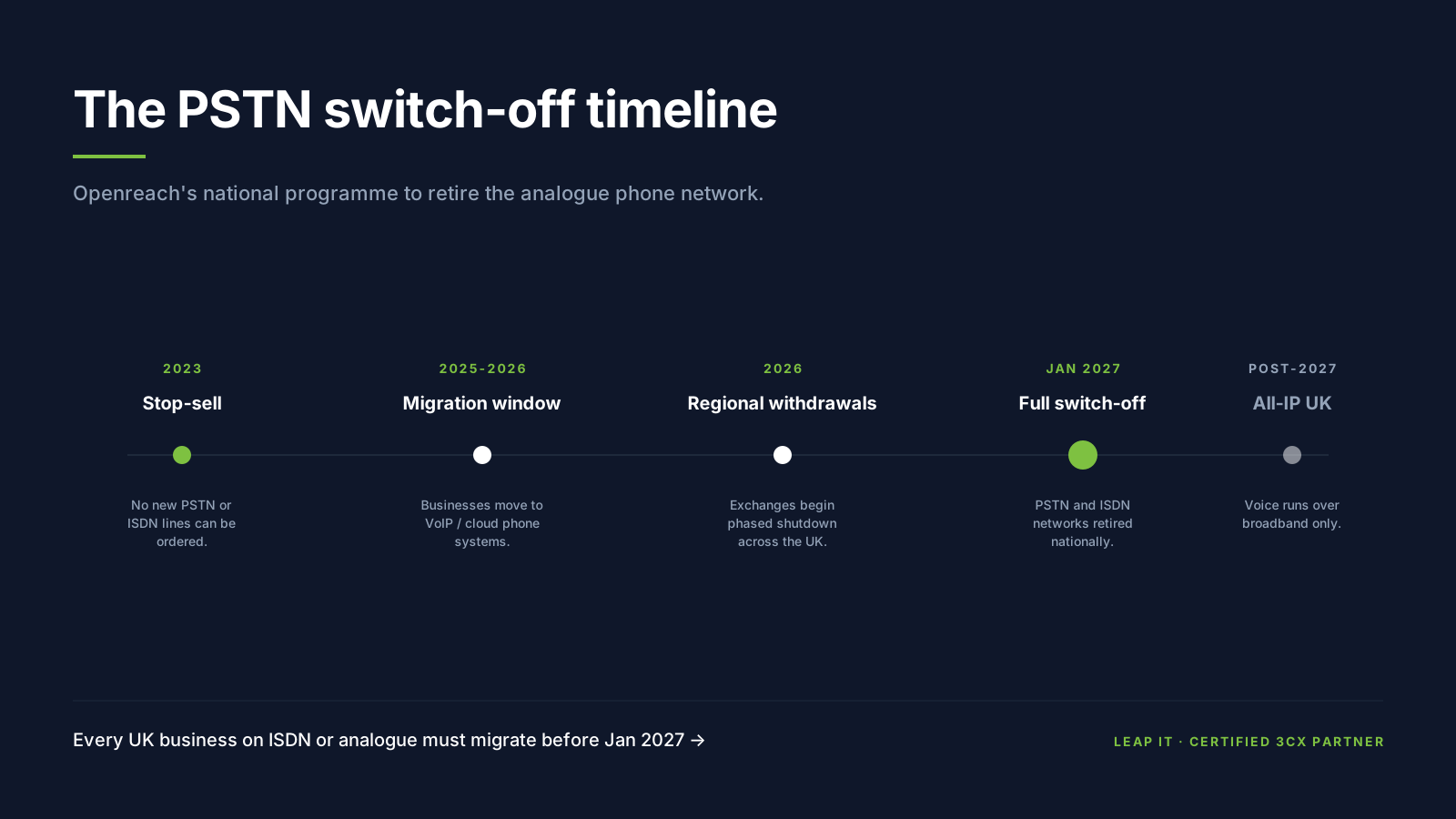
- 2023 - Stop-sell. No new PSTN or ISDN lines can be ordered anywhere in the UK. Existing lines still work.
- 2025-2026 - Migration window. The point at which most SMEs should be moving. Providers are actively contacting customers to migrate.
- 2026 - Regional withdrawals. Openreach begins phased shutdowns exchange by exchange.
- January 2027 - Full switch-off. All PSTN and ISDN services are retired nationally.
- Post-2027 - All-IP UK. Voice runs exclusively over broadband.
If you wait until late 2026 to plan, you'll be trying to book porting slots at the same time as everyone else who left it late. Number porting queues get long fast under that kind of demand.
What actually stops working
Anything that relies on an analogue phone line. It's worth walking your building because most businesses have more than they realise:
- Desk phones and switchboards on ISDN or analogue lines
- Fax machines (still surprisingly common in legal, healthcare and property)
- Alarm diallers - intruder, fire and lift alarms that phone a monitoring centre
- Card payment terminals with a dial-up backup
- Door entry systems and gate intercoms with dial-out
- Postage franking machines with automated top-up
- CCTV with dial-up upload
- EPOS systems with analogue backup
Any of these on a copper line needs either a like-for-like IP replacement or reconfiguring to run over broadband/4G. Alarms especially - the monitoring centre needs an IP-capable path or the alarm effectively goes silent after 2027.
Your options
There are broadly three paths, and the right one depends on how you actually use the phone.
1. Full VoIP phone system (most common for SMEs)
Software-based phone platforms like 3CX or Microsoft Teams Phone replace your PBX entirely. Calls run over your internet connection. Staff can answer on a desk phone, a laptop softphone, or a mobile app - same number, one system.
Best for offices, professional services, retail and any business with more than a handful of users. This is what most LeapIT clients move to, and where we spend most of our comms work.
2. SIP trunks into an existing IP-capable PBX
If you invested in a modern on-site PBX in the last few years, it may already support SIP. In that case you keep the handsets and system - you just swap the ISDN circuit for SIP trunks over your internet connection.
Cheaper transition, but the underlying PBX still needs vendor support and eventually replacement.
3. Single-line replacement (SoGEA/FTTP + VoIP adapter)
If you genuinely only need one or two lines - a small shop, a home office - a single VoIP number on a hosted platform is fine, plugged into an adapter or a mobile app.
For most business setups, option 1 is where the value is.
What VoIP actually gives you back
Migrating isn't just plumbing. Modern IP-based systems do things ISDN can't:
- One number across desk, laptop and mobile - staff work anywhere without giving out mobile numbers
- Auto-attendants and call routing without paying for a full switchboard
- Video meetings, chat and voice on one platform (particularly with Teams Phone or 3CX)
- Call recording, wallboards and reporting as standard
- Site consolidation - one system spans every office and remote worker
- Lower call costs - UK landline and mobile bundles are usually included
- CRM integration - inbound calls pop the customer record; outbound clicks-to-dial from the browser
The commercial argument is straightforward: you replace line rental, call charges and PBX maintenance with a single per-user monthly fee, and get a much more capable platform in the process.
How to migrate without breaking anything
The failure mode in a PSTN migration isn't the technology - it's number porting and cutover planning. Here's what a clean project looks like:
- Audit every line and every device. Not just the desk phones - the alarm, the lift, the card machine, the fax, the door entry. Anything with a phone socket gets logged.
- Confirm broadband is fit for VoIP. Check upload speed, packet loss and jitter. Add a second connection or 4G failover if voice is business-critical.
- Design the new system. Number plan, auto-attendants, hunt groups, out-of-hours routing, integrations, softphone/mobile mix.
- Order and configure. Provision the platform, deploy handsets, roll out apps, train users.
- Port the numbers. This is the sensitive step - real dates, real cutover, no room for slippage. Book porting slots well in advance.
- Cut over and decommission. Run in parallel briefly, cut over, then cancel the ISDN/PSTN circuits so you stop paying for them.
Get any of these wrong and you'll miss inbound calls the day of cutover - which for most businesses is the one thing that must not happen.
How LeapIT handles PSTN migration
We're a certified 3CX partner and we've already migrated dozens of West Midlands businesses off legacy ISDN and analogue lines. We know every number porting pitfall and how to avoid them.
Because a PSTN migration is a defined communications project, it follows our standard four-step engagement:
- Planning and Strategy - we discuss your current setup, every line and device that touches the phone network, and the way your team actually uses voice.
- Customised IT Plan - we design the replacement system around your users, sites and integrations, including number porting, handset choice and any 3CX / Teams Phone decisions.
- Seamless Implementation - our engineers handle deployment, porting and cutover with minimal disruption.
- Ongoing Support - the phone system sits alongside your IT support and cyber security under one UK-based helpdesk, so there's no "who do I call?" when something's wrong.
Number porting timelines are already tightening as the 2027 deadline approaches. The earlier you plan, the more choice you have.
Frequently asked questions
What is the PSTN switch-off?
The retirement of the UK's traditional copper-based phone network (PSTN and ISDN) by January 2027. Every voice service currently delivered over that network has to move to an IP-based replacement, typically VoIP over broadband.
When is the PSTN switch-off deadline?
January 2027 for the full national switch-off. Stop-sell has been in force since 2023 (no new PSTN or ISDN lines can be ordered), and regional exchange withdrawals begin from 2026.
What happens to my phone number after the switch-off?
Nothing, if you migrate before your line is withdrawn. Your existing landline numbers can be ported to a VoIP platform and continue to work as normal - customers reach you on the same number, on any device.
Do I need new handsets?
Not necessarily. Some modern PBXs and IP handsets can be reused with SIP trunks. Most SMEs on old analogue or ISDN kit will replace the handsets as part of the project, because IP desk phones are inexpensive and softphones on laptops/mobiles cover most use cases.
What about our alarm system, lift and door entry?
These need special attention. Anything using a dial-out over the copper line - intruder alarms, fire alarms, lift emergency phones, door entry, some card terminals - needs an IP-capable replacement path or it will go silent after 2027. Include these in your audit up front.
How long does a PSTN to VoIP migration take?
For a typical SME with 10-50 staff, plan for a few weeks from initial scoping to full cutover, driven mostly by number porting timelines. Complex multi-site migrations take longer.
How much does it cost?
It depends on your user count, number of sites, handset choices and integrations. Get in touch for a scoped quote - we'll audit what you have, design the replacement and give you a fixed price.
Get visibility once you're on VoIP
Once you've moved off PSTN and onto a modern platform like 3CX, you get something copper lines never gave you - live visibility of what's happening on your phones. Our 3CX Wallboard page covers how live queue stats, agent status and SLA thresholds can be pinned to a screen in reception, sales or the service desk. Existing clients can also jump straight to the working 3CX Wallboard wiki for view definitions and threshold guidance.
Don't leave it until 2026
The businesses migrating now have the most choice on porting dates, handsets and rollout timing. The ones who wait until Q4 2026 will be trying to book cutovers in the same queue as everyone else.
If you're still on ISDN, still have a fax on the wall, or just want to know what a VoIP setup would look like for your business - book a PSTN audit call →.
We'll walk your lines with you, tell you what needs to change and give you a fixed price to be fully IP before the deadline.